Overview

Jump to

Pearson

Prismacolor

Building Prismacolor's first drawing education app

Lead Product Designer

5 months · 2023–2024

0→1 / Mobile App / Digital Branding

My Role

Design Lead

Tech lead, Backend Engineer

Simon Ingeson

Mobile (iOS) Engineer

Jay Canty

Mobile (iOS) Engineer

Sam Skinner

Mobile (iOS) Engineer

Richard Pressler

Mobile (Android) Engineer

Ivan Toplak

Mobile (Android) Engineer

Nestor Marsollier

Mobile (Android) Engineer

Phil Carlson

Backend Engineer

Ali Halim 

Time

Sep 2023 to Jan 2024

Prismacolor has been a go-to for artists for nearly a century, but its presence has stayed almost entirely physical. When the team approached us with the concept for Prismacolor+, a video learning app that teaches drawing through their colored pencil products, the work was ambitious. It was the first translation of an eighty-year-old physical brand into a digital one, and the entire app was being built from scratch.

I led design across five months from concept to production, working with a cross-functional team of engineers across iOS, Android, and backend. We delivered a full app design system and production-ready screens for both platforms.

The app was built and ready, though it ultimately did not ship to the public. The work still stands as the foundation Prismacolor will build on for any future digital product.

In this project, I set out to answer two questions:

How might we translate Prismacolor's brand into a digital experience that preserves their identity?

How might we build a learning experience aspiring artists genuinely engage with?
Scroll to read the full story

Defining the digital brand

Defining Prismacolor's digital identity

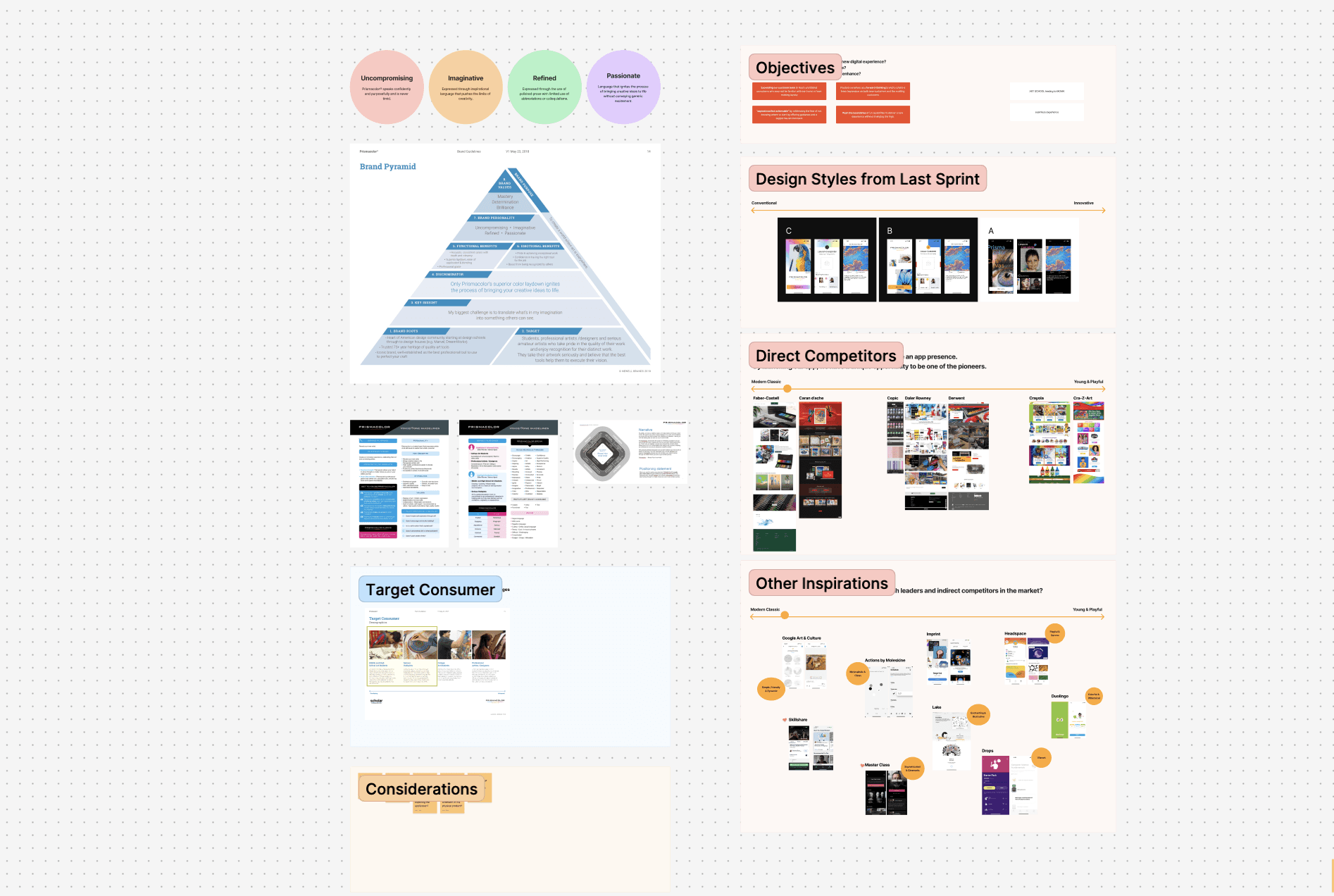
Explored and defined brand attributes

To explore visual directions, I designed and ran an initial brand workshop with the Prismacolor team. During the workshop, we surfaced what resonated about the brand and pulled inspiration from a wide range of digital experiences.

From those discussions, we landed on four brand attributes that would guide every visual decision after. Trust, welcoming, contemporary, and approachable.

Designed moodboards to test visual directions

Using those attributes as our compass, I designed three moodboard styles, each reflecting a different direction we could take. During the next workshop, I presented each option and facilitated a conversation to see what resonated. The Sophisticated Dark style emerged as the clear favorite and best aligned with Prismacolor's brand.

Tested the direction in concept designs

I then applied Sophisticated Dark to two concept design directions to see how it held up in context.

Working through them with the team, we landed on an experience that balanced subtle sophistication with moments of inspiration, stepping away from traditional swipe-based content patterns toward something more intentional and dynamic.

Together, we aligned on four elements that anchor the brand

By the end of the sprint, we aligned on four elements that would anchor the visual direction. A dark theme, interactive elements, gradient motifs, and a celebration of art and products.

Explored and defined brand attributes

To explore visual directions, I designed and ran an initial brand workshop with the Prismacolor team. During the workshop, we surfaced what resonated about the brand and pulled inspiration from a wide range of digital experiences.

From those discussions, we landed on four brand attributes that would guide every visual decision after. Trust, welcoming, contemporary, and approachable.

Designed moodboards to test visual directions

Using those attributes as our compass, I designed three moodboard styles, each reflecting a different direction we could take. During the next workshop, I presented each option and facilitated a conversation to see what resonated. The Sophisticated Dark style emerged as the clear favorite and best aligned with Prismacolor's brand.

Tested the direction in concept designs

I then applied Sophisticated Dark to two concept design directions to see how it held up in context.

Working through them with the team, we landed on an experience that balanced subtle sophistication with moments of inspiration, stepping away from traditional swipe-based content patterns toward something more intentional and dynamic.

Together, we aligned on four elements that anchor the brand

By the end of the sprint, we aligned on four elements that would anchor the visual direction. A dark theme, interactive elements, gradient motifs, and a celebration of art and products.

Defining the digital brand

Building The visual system

Building The visual system

From that foundation, I built three core elements of the digital identity that would carry through every screen of the app.

Representing the product

Representing the product

Prismacolor's reputation is built on the quality of its colored pencils, and portraying that product accurately on screen mattered as much as any other part of the brand. The pencils had to maintain their premium feel without appearing overly digital or artificial, real enough for users to connect with and trust on screen. To bridge that boundary between physical and digital, I designed two product elements that recur across the app.

Color swatches

Prismacolor's customers are deeply loyal to Prismacolor products and highly sensitive to color accuracy. We wanted users to experience the same depth and richness of color in the app as they do with the physical pencils. Through experimentation, I developed textured digital swatches that authentically replicate the look and feel of the color swatches featured on Prismacolor's distinctive packaging.

Colored pencils

I carefully studied the colored pencils to capture their shape, texture, and tips. Working with Prismacolor's design director, we translated those details into digital components that integrate seamlessly across the app. Our goal is to provide users with a tactile experience on screen, allowing them to connect with the authenticity of the product and bridge the digital and physical worlds as they embark on their creative journey.

Color swatches

Colored Pencils

Prismacolor's customers are deeply loyal to Prismacolor products and highly sensitive to color accuracy. We wanted users to experience the same depth and richness of color in the app as they do with the physical pencils. Through experimentation, I developed textured digital swatches that authentically replicate the look and feel of the color swatches featured on Prismacolor's distinctive packaging.

We carefully studied the colored pencils to capture their shape, texture, and tips, and then translated these details into digital components that seamlessly integrate across the app. Our goal is to provide users with a tactile experience on screen, allowing them to connect with the authenticity of the product and bridge the digital and physical worlds as they embark on their creative journey.

Structuring the learning experience

Scoping the MVP

Scoping the MVP

I worked closely with the engineering team and the Prismacolor team to define what the MVP needed to be. Together, we built a feature board to prioritize the essentials and estimate the effort required for each one.
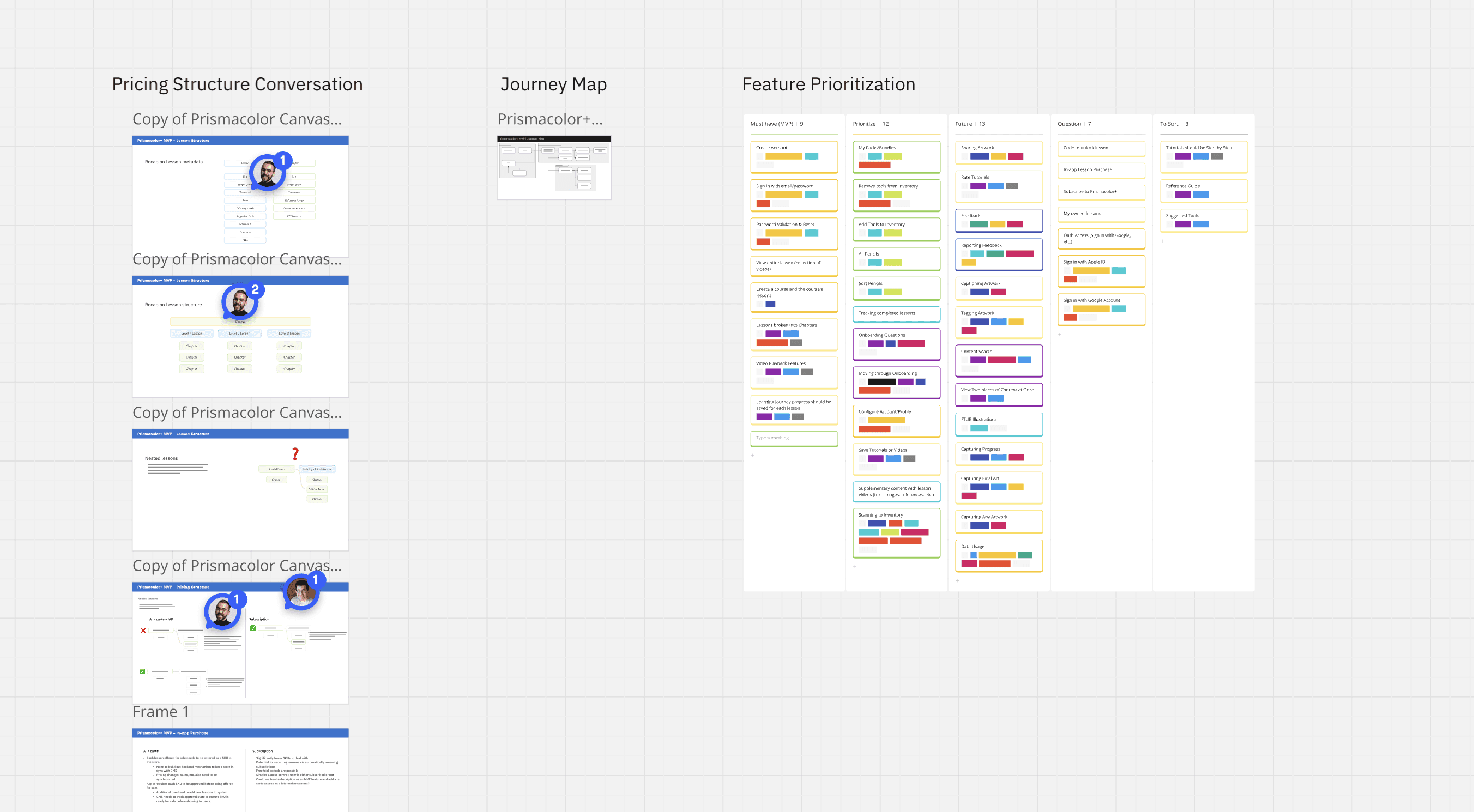
Through brainstorming sessions, user interviews, and testing we co-ran with aspiring artists, we discovered that the app's primary audience was seeking a more structured learning experience to motivate and guide their creative journeys.

These users wanted more than passive content. They craved clear progression, actionable steps, and moments of accomplishment to keep them inspired. Even if advanced features could not land in the MVP, those three things became the non-negotiables that guided every prioritization call.

Through brainstorming sessions, user interviews, and testing we co-ran with aspiring artists, we discovered that the app's primary audience was seeking a more structured learning experience to motivate and guide their creative journeys.

These users wanted more than passive content. They craved clear progression, actionable steps, and moments of accomplishment to keep them inspired.Even if advanced features could not land in the MVP, those three things became the non-negotiables that guided every prioritization call.

Lesson architecture and content

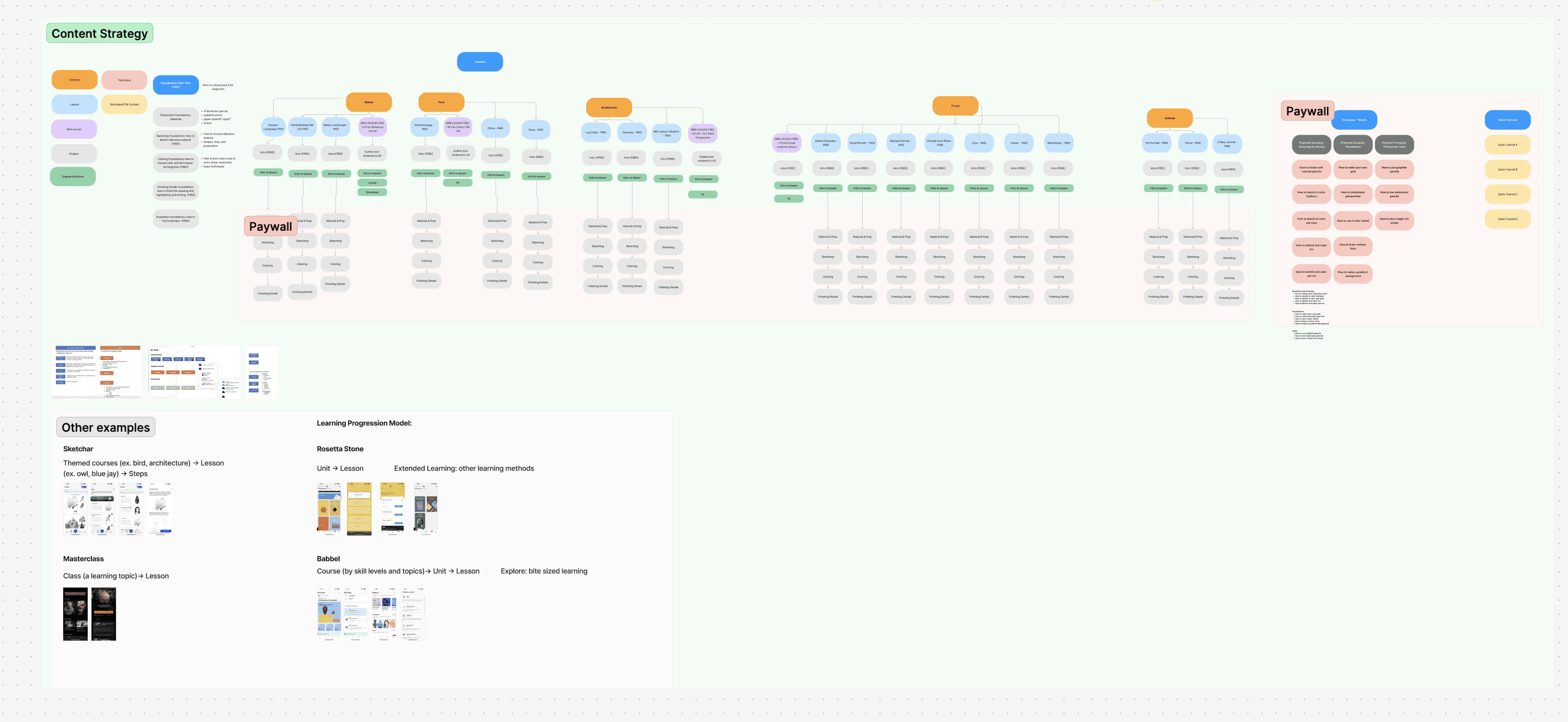
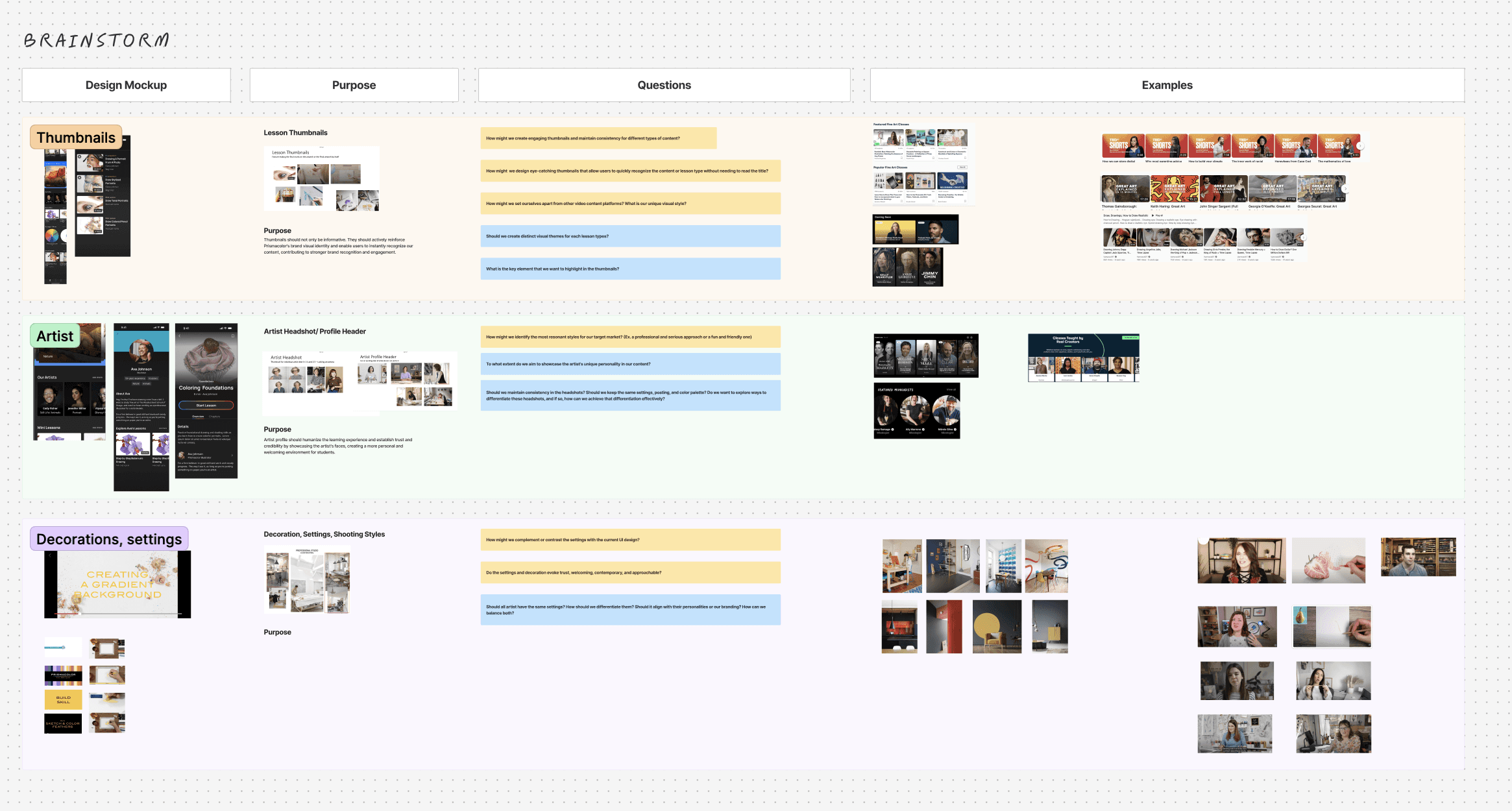
Before designing the experience, we need to define information architecture. I began by mapping the lesson library into candidate groupings, then ran short feedback sessions with aspiring artists to learn how they naturally grouped lessons in their own minds. From that work, we structured the library along those lines so the navigation felt intuitive in the moment and stayed scalable as more lessons were added.
Building the app

Brought the app to life with agile teamwork

Over five months, I worked with a team of 8 developers in agile sprints to bring the app to life. Each week, I led sprint meetings with engineering across iOS, Android, and backend, walking the team through every screen.
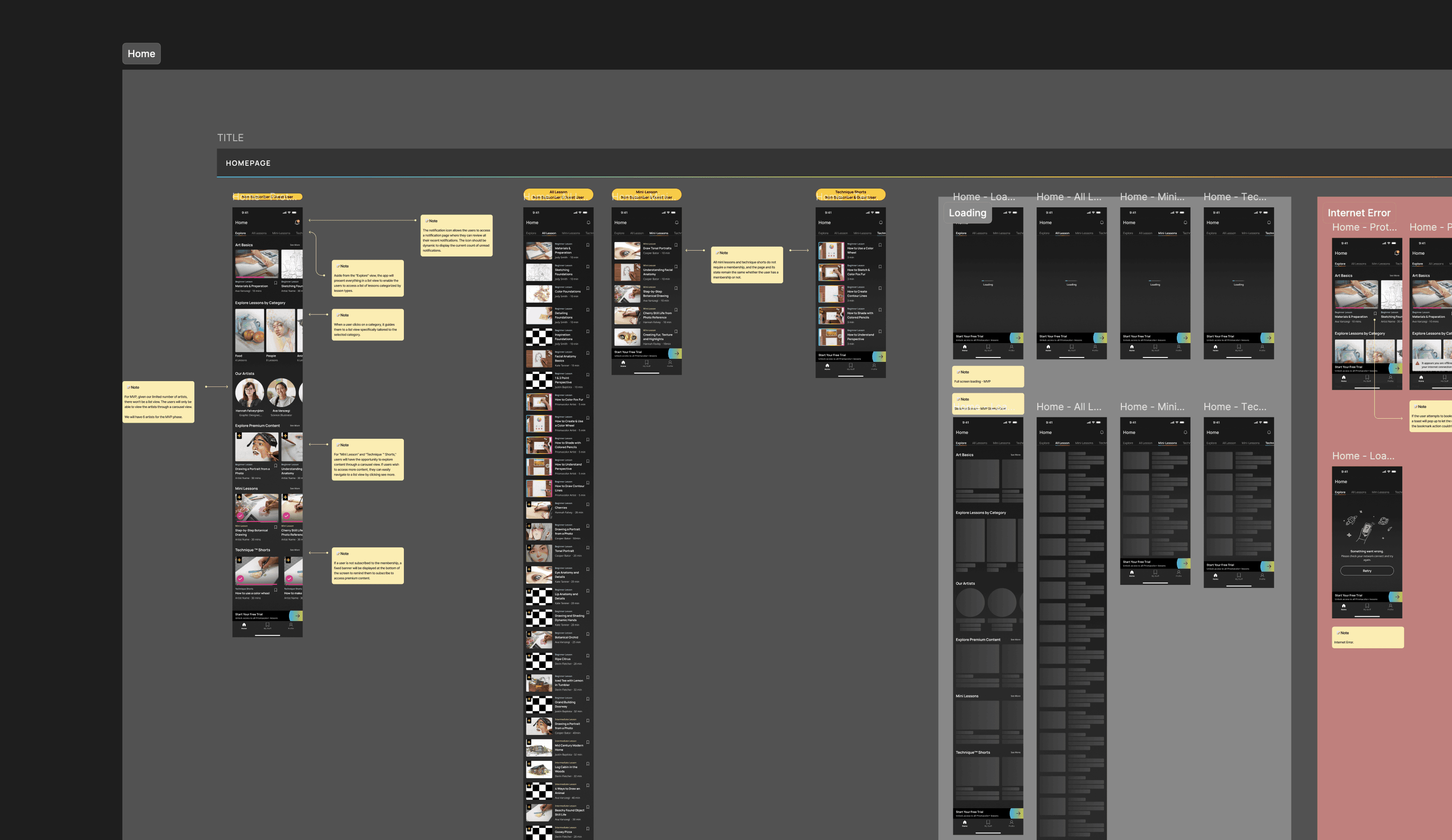
A key focus of my work was creating and documenting every screen with meticulous attention to detail. To ensure consistency and scalability, I also developed a comprehensive design system. This system not only streamlined collaboration across the team but also laid the foundation for maintaining a cohesive visual language throughout the app.
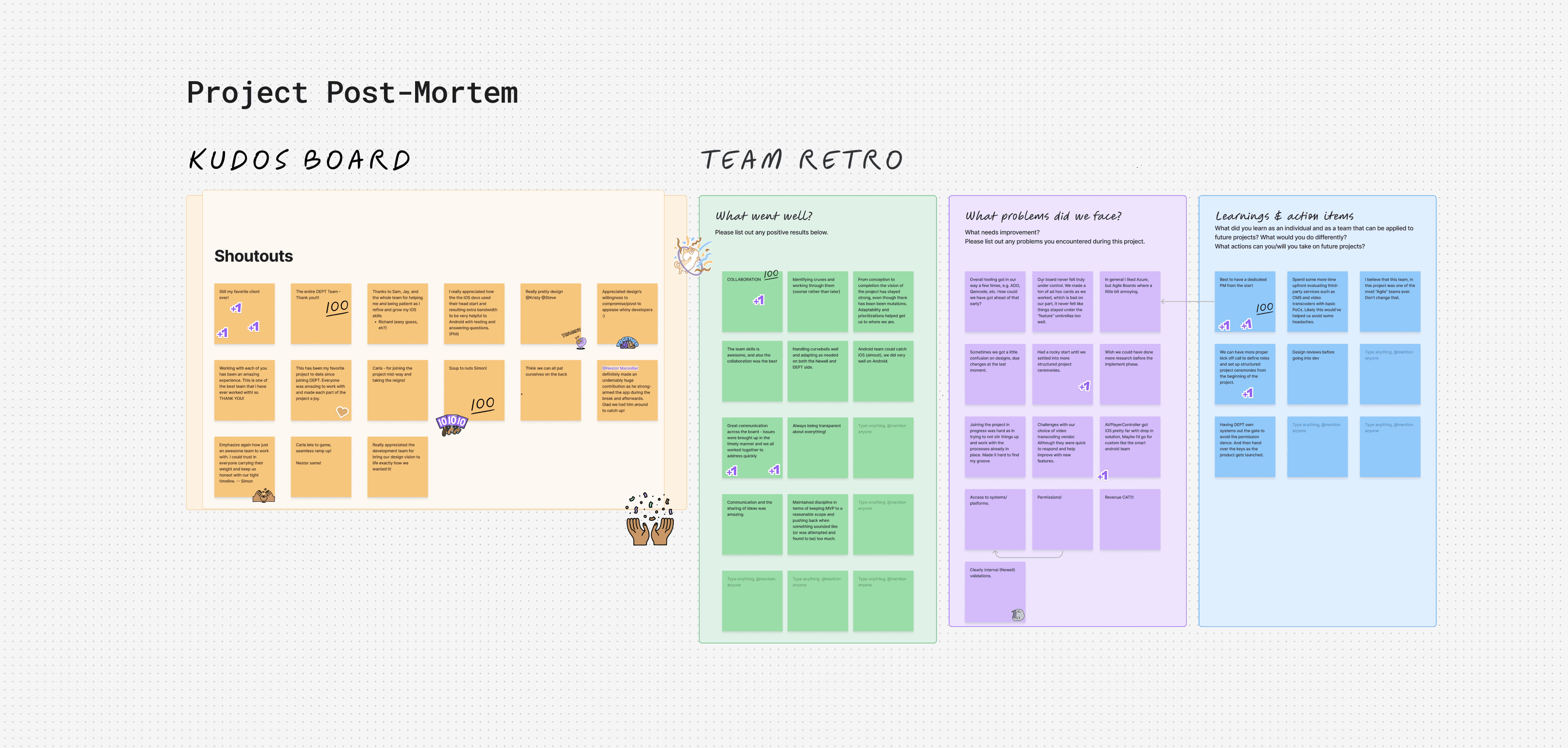
By January, we successfully got approval from both IOS and Android. Though the app did not ultimately go to market, but the design system and brand foundation are still what any future Prismacolor digital product would be built on.

Final Product

The App Experience

With the brand foundation and MVP principles in place, the experience design came together around three core moments aspiring artists move through. Inspire, Learn, and Celebrate. Each was designed to support a different point in the journey.

With the brand foundation and MVP principles in place, the experience design came together around three core moments aspiring artists move through. Inspire, Learn, and Celebrate. Each was designed to support a different point in the journey.

Explore

Learn

Celebrate

Explore and Inspire

The explore page is designed to feel inviting. Aspiring artists can browse through carousels and a tab menu. I designed the cards to work in both carousel and list formats, so content stays easy to scan however they choose to explore.

Explore

Learn

Celebrate

Learn

The lesson page is where the information architecture comes to life. Aspiring artists can follow a consistent learning experience across every lesson. I built the lesson structure and two card types, chapter cards and sketching exercise cards, that flex to fit different types of lessons.

Explore

Learn

Celebrate

Explore and Inspire

The explore page is designed to feel inviting. Aspiring artists can browse through carousels and a tab menu. I designed the cards to work in both carousel and list formats, so content stays easy to scan however they choose to explore.

Impact

The work continues

Though the app did not ultimately launch publicly, the work was built, approved on both iOS and Android, and remains the foundation for any future Prismacolor digital product. What the Prismacolor team holds today is a documented design system, a defined digital brand identity, and a full set of production-ready screens.

LET'S WORK TOGETHER

LET'S WORK TOGETHER

About

Let's talk!

About

Let's talk!

Kristy@thecreativeoutsider.com

© Kristy Chan 2026. All Rights Reserved